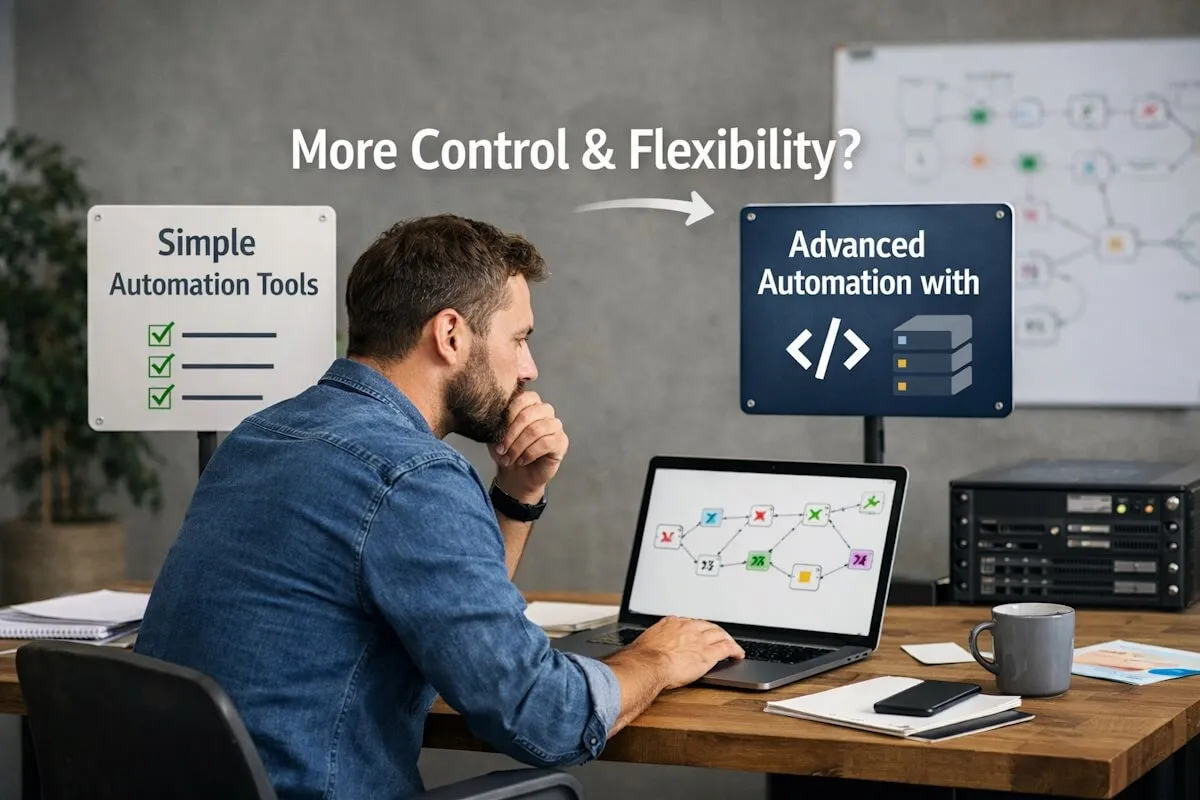
You’ve probably hit that point where manual tasks start piling up. One tool here, another app there, and suddenly you’re copying data between platforms like it’s your full-time job. That’s when workflow automation steps in.
But here’s the catch. Not all automation tools fit every situation.
Some are plug-and-play. Others give you deeper control. And then there’s n8n, which sits in a slightly different space.
So the real question is not “Is n8n good?”
It’s “When does n8n make more sense than other tools?”
Let’s break that down in a way that actually helps you decide.
What Makes n8n Different?
Most automation tools follow a similar pattern. You connect apps, set triggers, define actions, and that’s it. Pretty straightforward.
n8n does that too. But it doesn’t stop there.
It gives you control at a level many tools don’t. You can build workflows that go beyond simple “if this, then that” logic.
You can write custom logic. You can host it yourself. You can tweak how data flows at every step.
That changes how you think about automation.
Instead of asking, “Does this tool support my use case?”
You start asking, “How do I build this exactly the way I want?”
That’s a big shift.
When You Need Full Control Over Your Workflows
Let’s say your process isn’t simple.
You’re pulling data from multiple sources. You need to clean it, reshape it, and send it somewhere else. Maybe even loop through records or apply conditions that change often.
Many tools struggle here. They either limit what you can do or push you into expensive plans.
This is where n8n automation services come into play.
With n8n, you’re not boxed into predefined actions. You can:
- Add custom JavaScript
- Create complex conditions
- Handle edge cases without hacks
That means fewer compromises.
If your workflows feel “too specific” for typical tools, n8n is worth considering.
When Data Privacy Actually Matters
Some companies can’t just send data through third-party servers. Maybe you’re dealing with sensitive user data. Maybe your clients expect strict control.
Most automation platforms are cloud-based. Your data flows through their systems.
n8n gives you another option.
You can host it on your own server. That means your data stays with you.
No middle layer. No extra exposure.
If privacy is a serious concern for your business, this alone can be a deciding factor.
When You Want to Avoid Vendor Lock-In
Here’s something people don’t think about early on.
You build dozens of workflows on a platform. Everything works fine. Then pricing changes. Or features move behind higher tiers.
Now you’re stuck.
Switching tools becomes a headache.
n8n reduces that risk.
Because it’s open source, you’re not tied to a single provider. You can move your setup, customize it, and scale it on your terms.
If long-term flexibility matters to you, this is a strong reason to lean toward n8n.
When Your Team Has Technical Skills
Let’s be honest for a second.
n8n is not the easiest tool for beginners.
If you’re looking for something ultra-simple, there are easier options.
But if your team includes developers or technically inclined users, n8n becomes much more powerful.
You can go beyond drag-and-drop workflows and actually build logic that fits your exact needs.
This is where businesses often choose to hire n8n developers.
Why? Because once you unlock that layer, the tool becomes far more than just an automation platform.
It turns into a system builder.
When You Need Custom Integrations
Not every tool connects to every app.
You’ll eventually run into that one platform your business depends on that doesn’t have native support.
With many tools, that’s a dead end.
With n8n, you can build your own integrations.
- Use APIs directly
- Create custom nodes
- Handle authentication your way
That means you’re not waiting for someone else to add support.
You just build it.
If your stack includes niche tools or internal systems, this flexibility becomes a big advantage.
When Costs Start Adding Up
Automation tools often look affordable at first.
Then you scale.
More workflows. More tasks. More usage.
Suddenly, your monthly bill jumps.
n8n works differently.
If you self-host, your cost depends mostly on your infrastructure, not per-task pricing.
That can make a huge difference over time.
Especially for businesses running high-volume automations.
So if you’re trying to control long-term costs, n8n deserves a serious look.
When You Want to Build Scalable Systems
Some workflows start small.
A simple trigger. A basic action.
But over time, they grow.
You add conditions. You add branches. You connect more systems.
At some point, things get messy.
n8n handles this growth better than many tools because it’s built with flexibility in mind.
You can structure workflows in a way that stays manageable, even as complexity increases.
That’s important if you’re thinking long term.
Not just solving today’s problem, but building something that lasts.
When Other Tools Feel Limiting
You’ll know this feeling.
You try to set up a workflow. It almost works. But not quite.
You hit a limitation.
Maybe you can’t modify the data the way you need. Maybe you can’t create the logic you want.
So you start adding workarounds.
More tools. More steps. More confusion.
That’s usually the point where teams start looking at n8n.
Because instead of working around limitations, you remove them.
When You Want One Tool Instead of Many
It’s easy to end up with a stack of automation tools.
One for marketing. One for internal tasks. One for integrations.
That leads to fragmentation.
n8n can replace multiple tools in many cases.
You can centralize your workflows and manage everything in one place.
That simplifies operations.
Less switching. Less confusion. More control.
Situations Where n8n Might Not Be the Best Fit
Let’s keep this real.
n8n is not for everyone.
If you want something extremely simple and quick to set up, other tools might be better.
If your workflows are basic and unlikely to grow, you might not need the extra power.
Also, if your team has zero technical background, the learning curve can slow things down.
So it’s not about choosing the “best” tool overall.
It’s about choosing the right one for your situation.
A Better Way to Think About It
Instead of comparing tools feature by feature, think about your needs.
Ask yourself:
- Do I need deep customization?
- Is data privacy a concern?
- Will my workflows become complex over time?
- Do I want control over hosting and infrastructure?
- Am I trying to reduce long-term costs?
If most of your answers lean toward “yes,” n8n starts to make a lot more sense.
Final Thoughts That Actually Help You Decide
Picking an automation tool is not just a technical decision. It affects how your team works every day.
n8n stands out when you need control, flexibility, and room to grow.
It’s not the easiest option. But it’s one of the most adaptable.
If your workflows are simple today but likely to evolve, it might be smarter to start with a tool that won’t hold you back later.
And if you’re already feeling the limits of your current setup, that’s a sign worth paying attention to.
So, what kind of workflows are you dealing with right now?
Simple and steady, or messy and growing?
Your answer probably points you in the right direction.